Classical Explorations — May 2026
MAHLER, BY WAY OF PRAGUE
by Shea Lolin for Classical Explorations
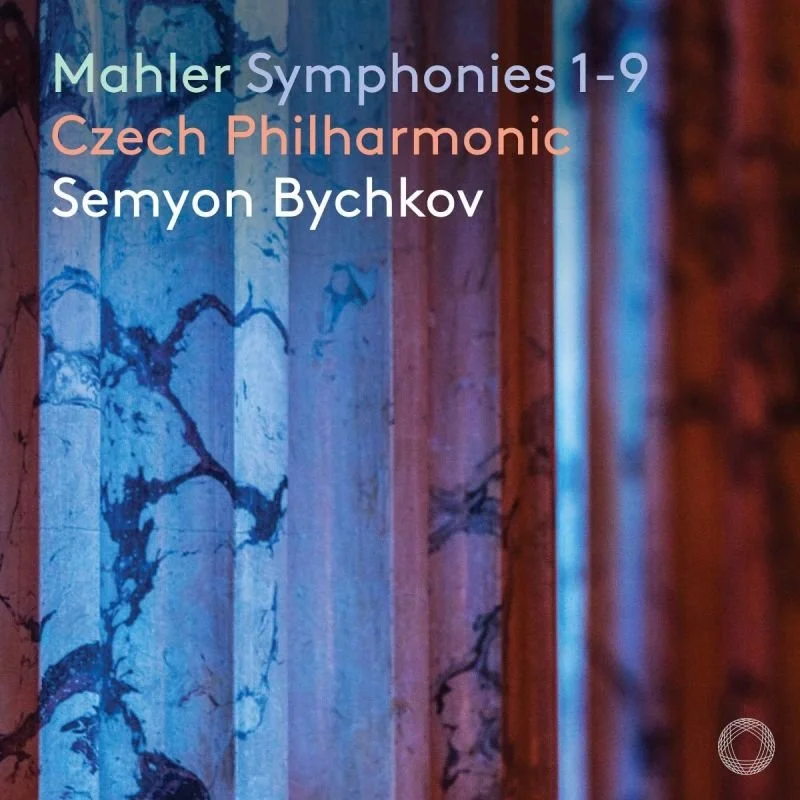
Semyon Bychkov and the Czech Philharmonic’s Mahler cycle is not something to rush through, but something to live with – an interpretation that reveals itself gradually, grounded in a sound and a tradition that feels instinctive rather than imposed.
A complete Mahler symphony cycle arrives with a certain sense of occasion. It’s the sort of thing that suggests you should probably clear a weekend, put the kettle on and “get through it properly.” I didn’t, and I’m glad.
Partly because binge listening rarely ends well, and partly because this didn’t feel like something to plough through in the first place, I took it one symphony at a time, left gaps between them, and more than once changed my mind about what I thought. That turned out to be an effective approach.
Even though four of the symphonies had already been released, the new set now hangs together as a complete entity. Not in a rigid, over-planned way, but in the sense that you’re hearing the Czech Philharmonic working through the same composer over time, figuring things out together. This is repertoire they don’t just play well – it’s in their DNA. That’s quite rare, and you can hear it.
What struck me quite quickly is that the Czech Philharmonic doesn’t try to tidy Mahler up. That sounds like a small thing, but it isn’t. The string sound alone tells you that. It’s not the polished, slightly glassy finish you might expect if you’ve grown up listening to UK orchestras. There’s more weight to it, more grain in the middle of the sound. You feel it a bit more. And that changes the balance of everything else.
Mahler needs that, I think. If the foundation is too refined, the whole thing can start to feel lofty. Here it doesn’t. It stays grounded, even when the music is doing everything it can to escape.
The First Symphony makes that clear without making a fuss about it. There’s no grand arrival, no sense of “this is Mahler, pay attention.” It just starts, and before long you realise you’re already inside it. That kind of understatement is harder to achieve than it looks.
Mahler doesn’t give you much room to hide, especially in the wind writing. It exposes everything: tone, phrasing, character. If something isn’t quite right, you hear it immediately. Here, what you notice isn’t brilliance in the obvious sense, but something more useful – lines that feel as if they are being spoken rather than performed. Take the Feierlich und gemessen – the funeral march in the third movement of the First Symphony. The rustic, dance-like episode is nasal, reedy in colour and just spot on. That is a wonderful moment in the cycle and deeply characteristic of Mahler. By the time you get further into the cycle, you start to notice how consistent that approach is. And that brings us to Bychkov, because none of this happens by accident.
There is a clear sense of direction in these performances. Bychkov is clearly attentive to detail, and that feels true here in music with such a strong sense of structure. But it does not feel controlled in a heavy-handed way. He does not press on every moment or try to make the music say more than it already conveys. In fact, there is a degree of restraint that becomes more convincing the more you listen.
You hear that particularly in the larger symphonies. The Sixth has real weight, but it does not sit on you. The Seventh, which can easily feel like a collection of good ideas in search of a plan, actually holds together here. And the Eighth – inevitably the one everyone looks at first – is handled with a degree of control that avoids tipping into excess.
Bychkov has been quite open about approaching the Eighth (“Symphony of a Thousand”) with a certain amount of caution, which feels entirely sensible. It is not a piece that benefits from being taken on as a conquest. The scale is already built in. If anything, the challenge is not to overdo it. And yet, for all that control, there are moments where the piece simply overwhelms you anyway. The close of the first movement is one of them. There is something about the way it builds and then arrives that feels completely unavoidable – not just towering, but inevitable.
It is one of those moments where, regardless of how analytical you think you are being, it cuts through all of that. You just react to it. And somewhere between what’s on the page and Bychkov’s interpretation, it becomes something awe-inspiring. Not in a grand rhetorical sense – just in the basic human sense that something has happened and you feel it.
Hearing the whole cycle together also shifts things slightly. These recordings were not done in one go. They have developed over time, and you can hear the relationship between conductor and orchestra settling into something more instinctive. By the later symphonies, it feels less like interpretation and more like a shared language. That sort of partnership does not appear overnight.
I have seen glimpses of it from the inside when I have worked with this great orchestra. Recording sessions have a habit of revealing weaknesses, especially when time is tight and people are tired. There is usually a point where things either drift or suddenly come together. Occasionally, if you are lucky, you get that last take where everything just clicks – not perfect, but alive. Those moments tend to stay with you. And you do hear traces of that here.
It also makes it easier to place this cycle more broadly. There is no attempt to reinvent Mahler, which is probably wise. What you get instead is a consistent, well thought-through reading across all the symphonies, with a clear orchestral identity and a conductor who understands when to intervene and when to leave things alone. That might sound like faint praise. It is not.
There is a lot of Mahler that tries very hard to be meaningful. Too much shaping, too much insistence. It can become heavy surprisingly quickly. This recording trusts the music enough to let it do its job.
I should probably admit at this point that I am not entirely neutral about any of this. I know the orchestra well enough now that it inevitably colours how I hear them. What I value most is the way they work. There is a willingness to engage, to adjust, to find something collectively rather than just deliver what is written down. That is not always a given.
I will be back in Prague this coming week to record with the Prague Metropolitan Orchestra in the Dvořák Hall, including the Adagietto from the Fifth Symphony – so it seemed like perfect timing to finish my thoughts on this symphony cycle. In some ways I am hugely looking forward to it and in others I feel slightly daunted by the responsibility, especially when many of these orchestral musicians recorded this very cycle! I am immensely proud to say that we will work with the same studio engineer and that gives me much comfort.
The Dvořák Hall is an acoustic that keeps you honest. Warm, yes, but not forgiving. If something is not working, you know about it fairly quickly. Which, in Mahler, is probably a good thing.
I did not rush this cycle, and I would not recommend that anyone else does either. Not because it is difficult, but because it reveals itself more gradually than that. The connections between the symphonies start to show, the sound settles, and it begins to feel less like a set of recordings and more like a long, ongoing piece of thinking.
It is an outstanding set. Five stars, without hesitation.
But more importantly, it is one I know I will come back to – not because I feel I should, but because there always seems to be more to discover in it.