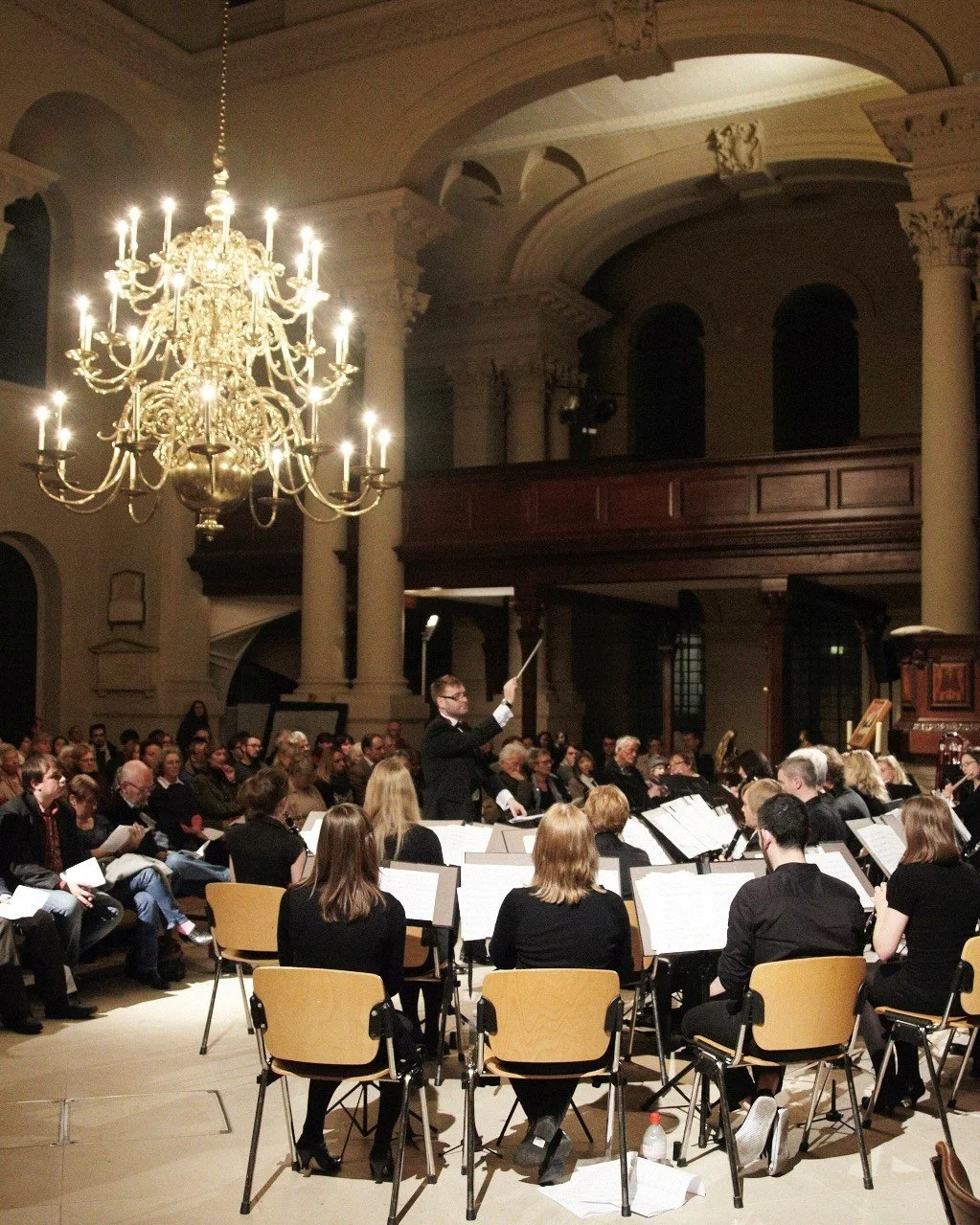
Conducting BWE in 2013
An interim return to Bloomsbury Woodwind Ensemble
20 March 2026
I will return to the Bloomsbury Woodwind Ensemble from May until November 2026, after which a new Musical Director will be appointed.
View the Musical Director position advertisement ›
Composers Workshop – Tuesday 9 June 2026
In my capacity as Chair of BASBWE, I will lead a composers’ workshop with the Bloomsbury Woodwind Ensemble, held in association with BASBWE. Participation is free of charge, and applications are warmly invited.
Find out more and apply ›
Concert: Tales of Midnight – Saturday 28 November 2026
I will conduct the Bloomsbury Woodwind Ensemble at St James’ Church, Sussex Gardens (Paddington) in a programme exploring folklore, darkness, and imagination after dark. The concert will feature the world première of Midnight Ocean by Stephen Chadwick – a new work for woodwind orchestra evoking the flow of water in the darkness, drifting forms touched by moonlight.
A few thoughts..
When I first stumbled upon the Bloomsbury Woodwind Ensemble, I was 22 – painfully enthusiastic and armed with little more than a well-thumbed score and a head full of ideas. The internet, then, was hardly the oracle it has since become; research took time, e-mails were sent, and auditions meant turning up in person, baton in hand and hope in heart.
The ensemble I found that day in 2005 was small, warm, and wonderfully human – perhaps ten or fifteen players, rehearsing in a borrowed room at the London School of Pharmacy thanks to a much-loved former member. The repertoire was modest: five-part arrangements of familiar classics, endearing if not exactly earth-shattering. But the people captivated me: project managers, pharmacists, psychiatrists – an eclectic microcosm of Bloomsbury itself. What bound them wasn’t just music, but curiosity, and a genuine desire to play better, do better, be better. That spirit lit something in me.
In the years that followed, that little ensemble became a creative home. We unearthed music by Philip Sparke, Adam Gorb, and others whose works breathed new life into the possibilities of the woodwind orchestra. Soon, “making do” wasn’t enough – we wanted to make our own. So together, we sought funding, commissioned new composers, and gradually built a repertoire that began to reflect the distinct voice of the group. By 2012, the Bloomsbury Woodwind Ensemble thrived so much that a second group had to be formed to accommodate the surge of players. From ten to seventy musicians – a small revolution powered by community, dedication, and the odd pint after rehearsal.
And then, silence.
The world shifted in 2020, as it did for everyone. I still remember standing on the steps of St Katharine Cree in Leadenhall Street – a rehearsal that never happened, a concert that never came. The radio delivered the news, and it was as though sound itself had been switched off. For a time, I wondered if music, at least in the way I knew it, would ever come back. Those two years of uncertainty tested me, both personally and professionally. Yet amid the stillness, the members of Bloomsbury supported me with remarkable kindness – proof that music’s worth isn’t just in what we play, but who we play it with. Eventually, with a heavy heart but deep gratitude, I stepped away after sixteen years at the helm.
Time, however, has a way of drawing familiar melodies back to the surface.
In 2025, as I was immersed in my Czech Philharmonic Wind Orchestra project (and raising 88% of an ambitious £15,000 goal), I found myself in a London pub with old friends and long-time collaborators, Colin Izod and Christopher Hill. Between reflections and laughter, the inevitable question arose: “So, what next?” As the drinks descended, so too did a shared certainty – that perhaps, some stories are meant to continue.
And so, this spring, I return to the Bloomsbury Woodwind Ensemble – not as the 22-year-old with big dreams, but as a conductor shaped by two decades of learning, challenge, and joy. Together, we’ll premiere a newly commissioned work by Stephen Chadwick, whose music bridges the worlds of television, education, and performance, alongside a host of fresh arrangements to be unveiled in November.
To stand before this ensemble again, baton ready, feels like closing a circle and opening another all at once. The landscape of music has changed – the world has changed – but that same pulse, that same curiosity that started it all, remains.
After twenty years, I’ve learned that conducting isn’t just about leading. It’s about listening – to people, to history, and to what comes next.